Sunday, November 29, 2020

How to Create the Best Facebook Cover Photos for Your Business

How to Create the Best Facebook Cover Photos for Your Business

It seems like every week there’s a new article about how people don’t use Facebook anymore. You may hear that it’s only for “old people,” that it’s not relevant, that brands are abandoning it.

Thing is, that’s just not supported by the user data. In reality, Facebook has barely seen a slowdown in audience growth at any point in the last 12 years. It’s been super consistent:
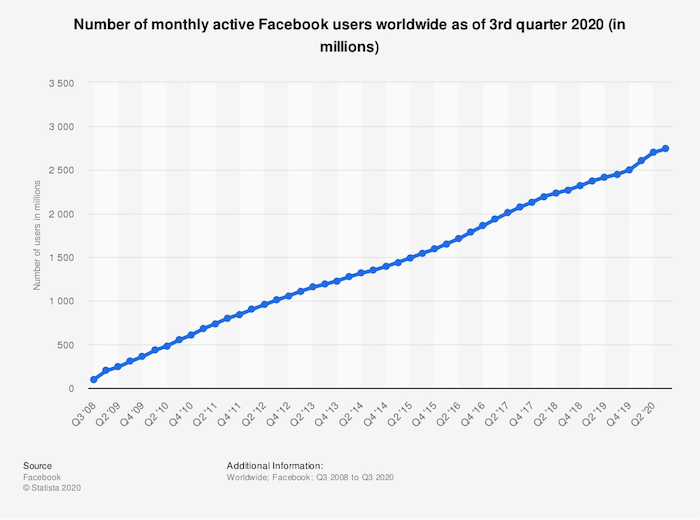
Facebook cover photo Monthly active users worldwide

With approximately 2.5 billion monthly active users, Facebook is comfortably bigger than Twitter, Snapchat, Reddit, and Instagram combined.
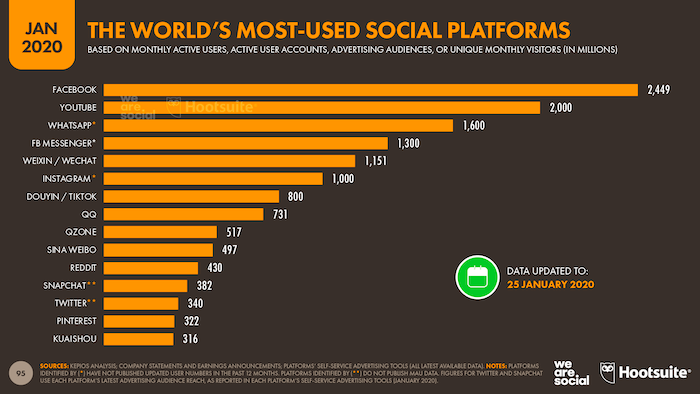
Facebook cover photo Facebook is the worlds most popular social network

So what does this tell us?

Simply put, if you’re a brand, you can’t afford to ignore Facebook. It might not be your audience’s favorite social platform, but they’ll almost certainly be on there, which means you need to be, too. You should be using it to promote your products, advertise your brand, and generally represent your company.

The starting point for all of those things is your Facebook Business Page. Your current and prospective customers or subscribers will visit it to check you out, see what you’re talking about, and engage with your content.

What’s the first thing they’ll see? Your Facebook cover photo. Read on to learn how to make a Facebook cover photo that shows off your brand in the best possible light.

Steps to Create an Effective Facebook Cover Photo

Ever heard of Hitchcock’s rule? Named for the legendary movie director, it states that the size of an object on-screen should be proportional to its impact on the story at that specific moment.

Well, given that your Facebook cover photo takes up almost half the page on desktop …
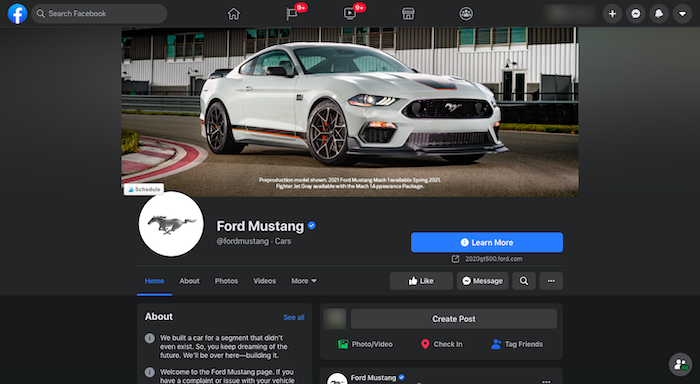
Facebook cover photo takes up almost half the screen

… it’s reasonable to say Facebook considers it pretty important! You’ve got a whole lot of digital real estate to play with, so you definitely want to make it count.

Designing a Facebook cover photo for your business page is much more than just choosing an eye-catching picture, cropping it to the right dimensions, and publishing it. Here are five key considerations to creating a cover photo that draws your audience in.

1. Keep Your Facebook Cover Photo Simple

Facebook used to say only 20 percent of your cover photo could be made up of text, but it dropped that rule in 2013.

With all that space to play with, and no limit on the amount of text you can include, it’s tempting to cram in as much information as possible. Don’t do that.

When it comes to creating an impactful Facebook cover photo, simplicity is your friend. Focus on communicating a single message as clearly as possible, so your audience is in no doubt of what you’re trying to say.

Apple does this better than most. While the tech giant famously doesn’t really “do” social, its branding on Facebook is still spot on.
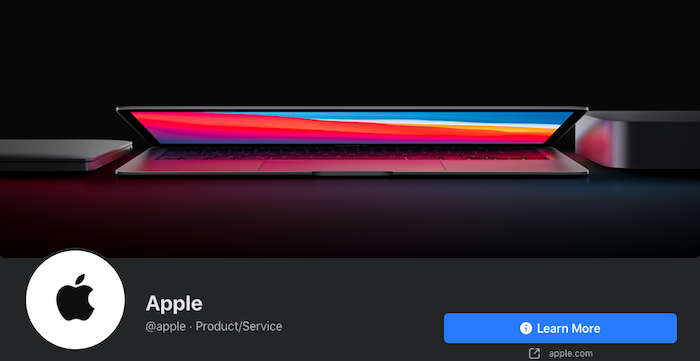
Apple Awesome facebook cover photo

Apple’s Facebook cover photo is an exercise in simplicity: no words, just one clean and instantly recognizable product image showcasing its iconic MacBook. The use of color is super effective, naturally drawing your eyes to the center of the image.

2. Complement Your Brand Through a Facebook Cover Photo

Can you sum up your entire brand in a single image? It’s not as simple as it sounds! But that’s exactly what you need to do with your Facebook cover photo. If it doesn’t complement your brand, you risk confusing your audience.

Adidas is a huge brand that sells everything from skateboarding sneakers to golf attire. It’s pretty tricky to encapsulate such a huge brand in one picture, so Adidas has chosen to combine three separate images for its Facebook cover photo.

Adidas Store Facebook cover photo complements its brand

This works really well, allowing the brand to speak to three different markets at the same time. In one cover image, Adidas encapsulates men’s and women’s sportswear, plus streetwear.

3. Keep Your Audience Front of Mind

As humans, we find it easier to connect with people than abstract concepts or inanimate objects. That’s why so many of the best Facebook cover photos feature images of people.

Of course, if you’re going to represent and speak to your audience through your cover photo, you first need to understand who they are. Fortunately, Facebook gives you a couple ways to find this out:

Facebook’s Audience Insights tool allows you to deep dive into the demographics, page likes, location, and Facebook activity of people who follow your page, are based in your area, or are interested in brands like yours. For instance, here’s a bunch of demographic information for people who like Major League Baseball:
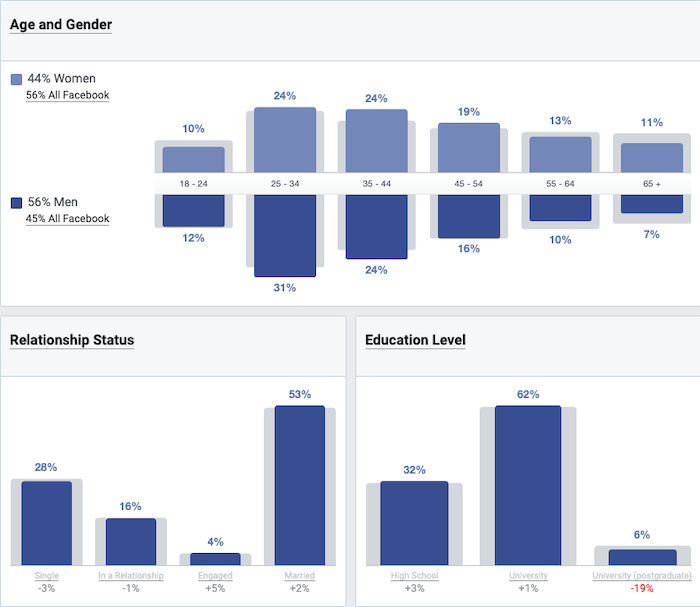
Facebook cover photo audience insight tools are important

By visiting your Facebook Business page, you can find out who engages with it most in the Actions on Page section. It shows you who clicked your contact information, call-to-action (CTA) button, or website, and segments the information by age, gender, device, and location.

So what does all this information tell us? Well, say you discover 80 percent of the people who follow your page are men, 75 percent live in Mexico and speak Spanish as their first language, and 90 percent are between the ages of 18 and 25. Your Facebook cover photo should probably incorporate a young Mexican man and maybe some Spanish text.

Here are a couple of examples of how Google targets its various audiences through its cover photos. First off, the brand’s UK Facebook page incorporates a bunch of cartoony imagery featuring recognizably British landscapes and structures like the Angel of the North, Stonehenge, and a red London bus.
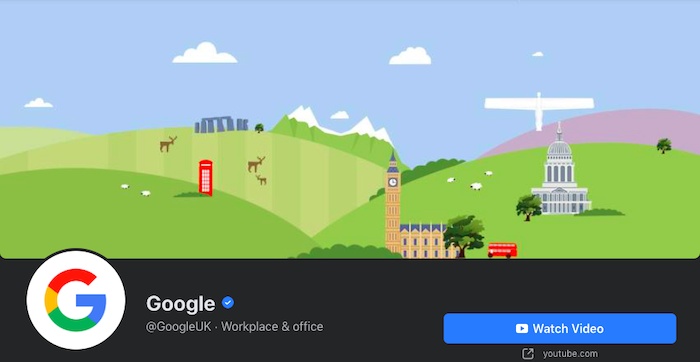
Facebook cover photo example how Google targets its audiences through cover photos

Meanwhile, the Google Students cover photo features pictures of young people from diverse backgrounds, often working in teams, and all using technology. In other words, they’re exactly the sort of people you’d expect to be interested in a Google page aimed at students.

Google Students Facebook cover photo

4. Pair the Facebook Cover Photo With Your Profile Pic

Just as your Facebook cover photo should complement your brand, it should also go hand in hand with your profile picture.

That’s really important because they sit alongside one another at the top of your Facebook Business Page. If they don’t fit together naturally, the results can be pretty jarring.

Nike is America’s most famous clothing and footwear brand, with 99% audience recognition, so it’s no real surprise that the company gets its Facebook branding perfect.
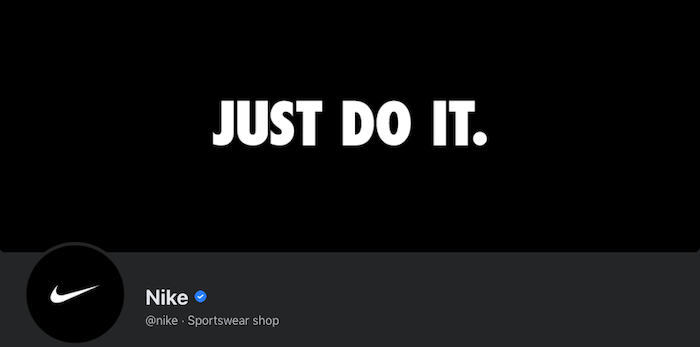
nike awesome facebook cover photo

With just three words, two colors, and the classic “swoosh” logo, Nike somehow manages to encapsulate its whole brand across its cover photo and profile picture.

5. Promote Your Products and Events Through a Facebook Cover Photo

When your cover photo takes up so much space, why wouldn’t you use it to talk about the things you want to promote? Whether that’s a new product, a special offer, a big piece of content, or an event, your cover photo is a fantastic place to show it off.

For example, PlayStation uses its cover image to showcase a high-profile new release for its PS5 console. Notice how the brand combines this with a CTA urging people to play the game, effectively transforming the top half of its business page into an interactive advert.

playstation awesome facebook cover photo

Taking things in a different direction, Gucci’s Facebook cover photo and profile picture are given over to promoting an online event, Guccifest.

Gucci awesome Facebook cover photo

Again, the fashion brand has added some interactivity by including a scannable QR code in its cover photo. The whole image is extremely text-heavy, which isn’t what you’d expect from a brand selling a physical product, but in Gucci’s case, this just makes the cover photo even more striking.

4 Steps to Designing an Impactful Facebook Cover Photo

Now that you understand the theory behind creating a striking Facebook cover photo for your business, it’s time to make it happen for your brand. Follow this simple four-step process to turn your Facebook cover photo vision into reality.

1. Pick a Facebook Cover Photo CTA Technique That Works for You

Take another look at all those Facebook cover photo examples I included above. None of them could appear in all five sections.

The PlayStation example is really effective at promoting a product, but it arguably doesn’t pair up well with the brand’s profile picture. Nike keeps things simple, complements its brand, and matches its profile image, but doesn’t directly feature its audience or showcase a product.

Does that mean they’re all bad cover photos? Far from it. Instead, this demonstrates that your Facebook cover photo shouldn’t be all things to all people. Pick out one or two of those techniques and use them to inform your image. For instance:

  • About to launch a high-profile new product? Use your cover photo to promote it.
  • Got a really specific audience? Speak directly to them in your cover photo.
  • Have a recognizable logo or slogan? Keep your cover photo super simple; let your branding do the talking.

2. Choose a Facebook Cover Photo Editing Tool

You don’t need to be a skilled graphic designer to create an effective Facebook cover photo. There are tons of easy-to-use, free photo editing tools that do all the hard work for you.

Arguably the most popular is Canva. It’s free to sign up and features a bunch of Facebook cover photo templates cropped to the correct dimensions. To find them, create your own Canva profile, select social media imagery, and choose the dedicated Facebook Cover option:
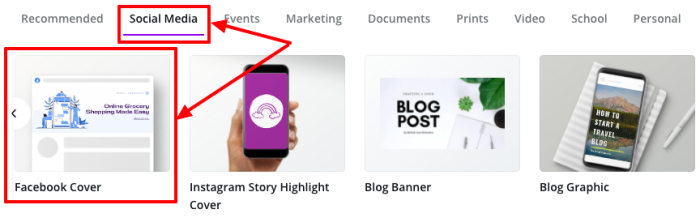
Use Canva to create a Facebook cover photo

Just one word of caution here: While Canva is free to use, you’ll need to pay for some of the design elements.

There are lots of other options, too. If Canva isn’t working for you, try PicMonkey, Visme, Snappa, Bannersnack, or countless others.

3. Start With a Photo

Again, unless you’re a qualified graphic designer (or have access to one), you’re likely looking for the simplest possible way to create an impactful Facebook cover photo.

In that case, you definitely want to start by finding a suitable image. Something that encapsulates your brand and speaks to your audience.

Just as there are lots of brilliant graphic design tools available online, there are also tons of fantastic free stock image libraries packed with hundreds of thousands of visuals you can use to design your cover photo.

Alternatively, feel free to incorporate your existing website imagery if you’re planning to use your cover photo to showcase a product or service.  

4. Remember to Use the Right Facebook Cover Photo Size

Last but not least, you must use the right dimensions for your cover photo. Otherwise, Facebook will crop or stretch it and all your hard work designing a beautiful, eye-catching image will be wasted.

So what are the right dimensions? There’s no easy answer, as frustrating as that sounds. Because 70 percent of Facebook users access the site on their phones, your cover photo has to work across both desktop and mobile. Yet cover photos display differently based on the device you’re using:

  • On desktop, the cover photo displays at 820 pixels wide by 312 pixels tall
  • On mobile, it displays at 640 pixels wide by 360 pixels tall

If you want to use a single image that works across both formats, Buffer recommends cropping it to 820 pixels wide by 462 pixels tall.

As an absolute minimum, Facebook says your cover photo should be 400 pixels wide and 150 pixels tall. It also advises keeping your image to less than 100 kilobytes for the fastest-possible loading.

Conclusion

Remember that your Facebook cover photo isn’t just a striking image. Choosing the right one for you isn’t necessarily about utilizing the brightest colors or the boldest copy.

It has to tie into your brand, speak to your audience, and effectively communicate your message. Ideally, anyone who knows your brand already should find it instantly recognizable.

If you’re struggling, remember the value of keeping things simple. Don’t try to be too abstract or clever. A basic image that clearly represents who you are and what you do will be much more effective than something complex that leaves people scratching their heads.

How are you using your Facebook Business Page to generate leads or sales?

The post How to Create the Best Facebook Cover Photos for Your Business appeared first on Neil Patel.

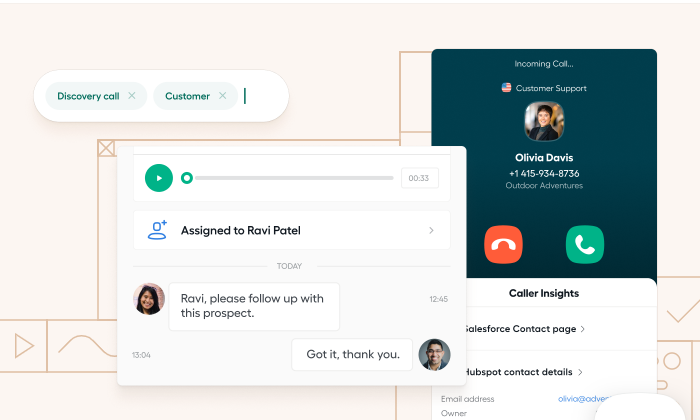
Best Call Center Software

Disclosure: This content is reader-supported, which means if you click on some of our links that we may earn a commission.

What would it be like for your business to never miss another call?

Nothing scares away new business like hard-to-reach customer service or disorganized sales calls. Adopt the best call center software and you will outfit your teams with the tools they need to communicate effectively.

Today, an affordable call center is within reach of any business with an internet connection. 

Forget about the requirements of a physical office space, infrastructure, or even a business phone system.

Modern call center software is all you need to get up and running. You still have the hard work of engaging your customers and clients, but all the heavy lifting associated with maintaining a call center is off your plate.

The Top 5 Options For Call Center Software

  1. Five9 – Best for Blended Call Centers
  2. Aircall – Best for Collaboration
  3. 8×8 Contact Center – Best for Enterprise
  4. Dialpad – Best for Startups
  5. Talkdesk CX Cloud – Best for Best for Salesforce Integration

How to Choose The Best Call Center Software For You

I make calls when I’m thinking about committing to a new product or service. Lots of people do. 

The human connection is real, intimate, and—unfortunately—easy to mess up.

One dropped call. One mistaken name from an agent who’s spoken to 35 other people within the hour. 

It doesn’t take much to lose a lead or earn a 1-star review carved in digital stone on the internet.

You’re looking for a system that establishes trust with customers because they know they can call and speak with the right person quickly. 

It must also come with an interface that empowers agents by giving them insight into calls, client histories, and any other information they need to resolve issues in real-time.

Customers need prompt answers from helpful agents. End of story.

The best call center software comes with everything you need to meet these two fundamental call center objectives, and much more. 

Let’s go through the core call center features that help businesses make their customers happier and their agents more productive.

Calling Capabilities

Blended call center software will let the same agent receive incoming calls and make outgoing calls. This isn’t the case with every product, as some are limited to a single direction: inbound or outbound.

This can work to your advantage.

If you only need one or the other, you may be able to get a less expensive plan that’s easier to secure and manage. A helpdesk might only need inbound and a sales team might be fine with outbound calls only.

Dialing Capabilities 

For outbound call centers, having the right dialing capabilities can make a huge difference in terms of agent productivity (and sanity). The four types you are likely to see are:

  • Preview dialer: Lets an agent review contact information before they call
  • Progressive dialer: Automatically dials one contact per available agent
  • Power dialer: Automatically dials multiple contacts per available agents
  • Predictive dialer: Automatically dials based on predicted agent availability

Dialers decrease an agent’s down-time considerably and completely eliminate the manual grind process of making calls from their cognitive workload.

Channels

Call center software should be able to accommodate every channel you currently use or plan to use in the future. If you see something billed as omnichannel, it should cover:

  • Phone
  • VoIP
  • Email
  • SMS
  • Chat
  • Social
  • Video

Ensure that whatever product you choose will let customers interact seamlessly with agents across all supported company channels.

Call Routing

Call center software comes with routing features that segment and direct incoming calls, potentially automating the processes which connect callers with the expert or agent they seek.

Some of the popular call routing features explained:

  • Automatic Call Distribution (ACD): Greets customers and allows them to select from a main menu or enter extension to route themselves. 
  • Automated attendant: Takes calls when all agents are busy, plays hold music, relays wait times, and reminds callers that their time is valuable.
  • Intelligent call routing: Uses automation, AI, or interactive voice response to route customers to the most appropriate agent.
  • Mobile device routing: Allows calls to be routed to mobile devices.
  • Omnichannel routing: Allows calls to be routed across any channel.
  • Virtual hold: Gives customers the option to receive a call back when an agent is ready, instead of waiting on the phone.
  • Warm transfer: Lets customers speak to a new agent before the call is transferred, and allows the previous agent to explain any ground that’s already been covered.

If call center software comes with intelligent call routing, it’s safe to assume it can handle most, if not all, of the capabilities listed above.

Interactive Voice Response 

Interactive voice response (IVR) enables customers to use a phone system to access information from a connected database. This could be someone calling to find out their checking balance, hear the status of their order, or pay a bill.

If you have customers routinely calling to access information, you can free up a lot of phone time simply by implementing IVR. It’s a truly self-service solution that helps people get what they want, without ever talking to an agent.

Call Recording

You have probably heard a thousand times that “this call is being recorded for safety, security, or training purposes.” Well it’s all true.

Call recording is extremely important. Supervisors can listen back to trainee calls and give advice about how to improve. In the event of a legal or compliance issue, call recording will cover your bases.

Good call center software makes it as easy as possible to save and store every call in a highly organized, searchable database. If you integrate your CRM, every recording can also be tied to the appropriate customer or client account.

One advanced call recording feature that can be really useful for sales teams is voicemail-to-email. This sends an email with an audio attachment or transcription of the voicemail to the account owner who missed the call. This is a huge time saver, especially for agents who are remote and on the go.

Workforce Management 

How efficient is your call center? How do you know?

Reporting and analytics are important features of modern call center software. Look for products with both historical and real-time reporting capabilities to support workforce management and optimization.

By tracking key metrics about calls, wait times, and first contact resolution, among others, those in supervisory roles are better able to forecast staffing needs to fit fluctuating demand.

Integrations, APIs, and SDKs

Put key customer data in front of your agents by integrating customer data sources with your call center software. The top products come with seamless integrations that work out of the box with leading CRMs like Salesforce and Microsoft Dynamics.

Many top call center software options have APIs and software development kits (SDKs) that allow you to build out custom solutions.

The better connectivity you can provide, the richer the customer information your call center will collect. 

Done right, you’ll provide marketing, sales, and customer service with data-driven insights to steer their efforts.

Security

Even if your customers aren’t giving their social security number over the phone, they’re sharing personal and potentially sensitive information. It’s unpleasant to imagine how much havoc an attacker could cause with full access to a database of client conversations.

Consider potential vulnerabilities that come with deploying call center software. Does it integrate with your current security stack? If not, be sure to add the cost of securing your new IT perimeter to the total cost of ownership.

The Different Types of Call Center Software

It’s getting less and less important for call center solutions to offer traditional business phone systems. Some do, but most are focused on helping companies migrate gradually to a centralized, cloud-based, multi-channel interface.

As important as the phone is, the reality is that customers are reaching out on more and more channels. 

This is why you’ll see the name “call center” being dropped in favor of “contact center.” 

It simply reflects that companies have to be able to respond however they are contacted: phone, chat, email, and so on.

Whether you are starting from zero or looking to modernize your existing system, picking the right type of call center software is the first step.

On-Premises Call Center Software

Many companies still maintain their own call centers and it can be important to keep everything in house for compliance reasons.

If this is a concern, make sure you choose an option that supports your infrastructure needs.

Cloud Call Center Software

Cloud-based call center software provides the same capabilities as a traditional call center, but it’s delivered as a service. Companies don’t have to manage any of the hardware or software.

A SaaS call center can be deployed in just a few hours or days, since there isn’t much required beyond headsets and devices to work from.

It’s very easy to run a distributed or work-from-home call center with a cloud-based solution, which is another reason these solutions are so popular.

CCaaS

Contact Center as a Service (CCaaS) centralizes all of the channels your teams use to communicate externally. 

Whereas a cloud call center may only give you VoIP, a CCaaS solution is going to loop in text, chat, social, and video as well.

UCaaS

Unified Communications as a Service (UCaaS) has all the capabilities of a CCaaS, with an additional focus of integrating legacy communication technology like fax and teleconferencing.

These products truly unify all forms of communication, helping companies adopt future-proof solutions as they phase out old equipment.

#1 – Five9 — Best For Blended Call Centers

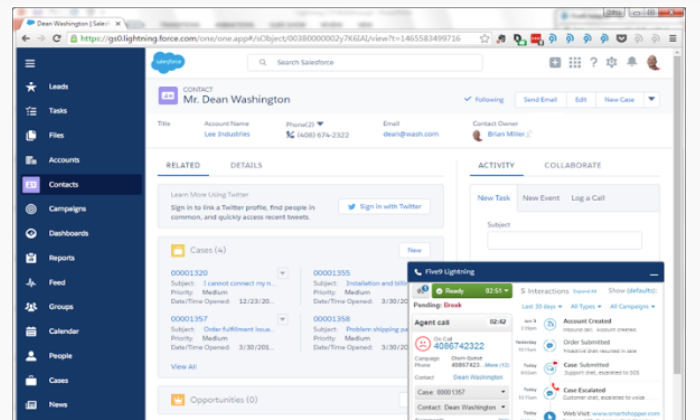
Five9 empowers call center agents to deliver the best possible experience to their customers by providing true omnichannel functionality from anywhere within an intuitive interface.

Agents can switch between chat, email, mobile, social, video, or voice to maintain seamless customer interactions.

Plus, integrations with top CRM platforms mean that all data is captured, providing an end-to-end contact center solution. Whether agents are reaching out or picking up a call, they always have current information about who they’re speaking with.

There are also built-in workforce management tools that make accurate forecasting and scheduling much easier.

For all the power of Five9 call center software, it’s not overwhelming, and people can quickly master the tools at their disposal, such as:

  • Predictive, power, progressive, and preview dialers
  • Intelligent omnichannel routing
  • IVR
  • Historic and real-time analytics dashboards
  • Six built-in CRM integrations
  • Cloud APIs and SDKs

Blended call centers will definitely notice increased efficiency using Five9. Active blending, one of the intelligent routing features, automatically sends inbound calls to agents working outbound campaigns when call volume is high.

Five9 pricing is based on whether you want inbound, outbound, or blended service. You’ll have to get in touch with sales, but there are three options for how to pay:

  • Monthly on-demand
  • Per-minute fees
  • Annual contracts

The lowest price will come with an annual contract, but companies can scale quickly at low cost with on-demand pricing if need be.

As sleek as it is, Five9 is one of the top call center solutions for companies that need to integrate legacy technology. If you’re thinking about using a cloud-based solution for your blended call center, Five9 can help no matter where you are starting from.

#2 – Aircall — Best For Collaboration

Aircall is a CCaaS you can deploy this afternoon.

The VoIP quality is great, calls don’t drop, and agents can work from anywhere on their laptop or personal mobile device. It’s a great solution for virtual cloud call centers because of the built-in security, workforce management, and collaborative features.

Customers can leave voicemails which can be quickly assigned to the right person. New hires can listen into calls to hear what good service sounds like. In fact, you can host up to five people on the same live call.

One of the biggest perks for teams is the ability to assign, tag, and comment on calls. This is so helpful—assign the call to an individual, tag it to a specific department, and leave a short explanation about what’s going on.

It’s not that other call center software can’t do this—it’s just easier in Aircall.

For all the ease of using Aircall, it is a complete CCaaS that provides 

  • Automatic call-back
  • Intelligent call routing
  • IVR
  • Power dialer
  • One-click CRM integrations
  • Call center analytics

Aircall pricing is broken down into three tiers:

  • Essentials: starting at $30 per user/month
  • Professional: starting at $50 per user/month
  • Custom: contact sales

One quick thing: Salesforce integration only comes at the Professional tier, whereas integrations for Pipedrive, Zendesk, Hubspot, Slack and more than 60 others come with Essentials.

Aircall still supports traditional phone systems, which makes it an attractive option for companies that want to expand their call center operations to the cloud at their own pace.

#3 – 8×8 Contact Center — Best For Enterprise

8×8 Contact Center is one of the more robust tools on the market. 8×8 has been around for a long time and can fully support migration to a UCaaS call center.

It’s a powerful solution that can help large organizations in particular. Build out complex IVR paths, optimize a large workforce, and process payments all within a navigable interface.

There may be a little more of a learning curve with 8×8 than with other call center software simply because the platform is so feature rich. 

That said, once you have everything set up, the support and online documentation is enough to help people take advantage of 8×8’s advanced features, including:

  • Call and screen recording
  • Predictive dialer
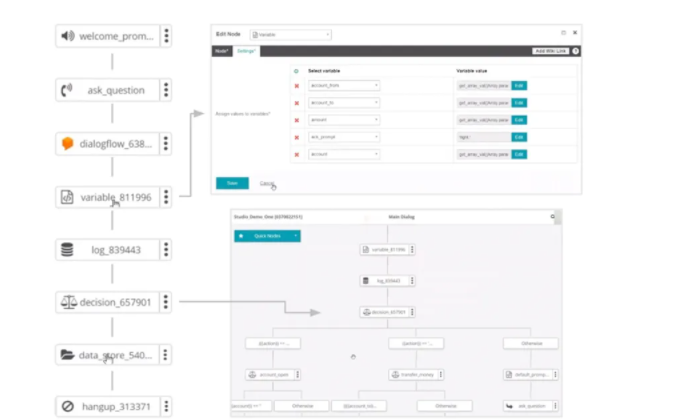
  • Drag-and-drop IVR designer 
  • Speech analytics
  • Customer surveys
  • Native CRM and integrations with top products

The pricing for 8×8 Contact Center breaks down into three tiers:

  • Contact Center – Voice
  • Contact Center – Omnichannel
  • Contact Center – Advanced

8×8 is not going to be the most budget-friendly option, even at its voice-only tier. 

To include digital channels, you will need the Omnichannel plan. For speech analytics and screen recording, you will need Advanced.

For voice-only call centers, other options from this list will meet your needs at a lower cost. If you are trying to build out an omnichannel contact center, however, 8×8 will give you a level of visibility and control that lighter products can’t.

#4 – Dialpad — Best For Startups

Dialpad is a next-generation UCaaS that completely supports today’s on-the-go, distributed workplace. Choose Dialpad for agile, constantly improving call center software.

You can add agents via the web client or Dialpad app. Both are updated frequently for security and to add new features.

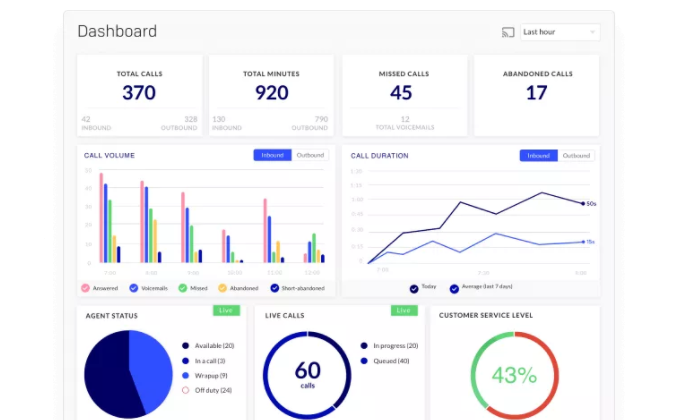
For all the flexibility provided to end-users, Dialpad doesn’t skimp on the backend reporting, recording, or monitoring features. This is huge for companies that are still trying to figure out what’s important.

With Dialpad, your team can assess KPIs and discover meaningful trends in real-time. Simply integrate your CRM and watch as Dialpad surfaces the most important metrics from calls on clean dashboards or highly-visible leaderboards.

Some of the other great capabilities of Dialpad include:

  • IVR
  • Seamless mobile routing
  • Call/Voicemail transcription
  • Warm transfer
  • APIs and webhooks
  • Integrations with top SSOs, CRMs, G Suite, and Microsoft 365, 

There are two plan options for Dialpad Contact Center:

  • Pro: starting at $225/month for 3 agents
  • Enterprise: contact sales, 100 agent minimum

Businesses thrive with Dialpad because of its efficiency. Deployment is simple, integrations are tight, and it performs extremely well for organizations with many remote workers. 

#5 – Talkdesk CX Cloud — Best For Salesforce Integration

Talkdesk is a leading CCaaS product that works well for large organizations who need to scale their contact center operations. Quickly provision new agents and securely connect them to sensitive customer data, no matter where they are.

It’s a feature-rich, yet very approachable, solution. People who have never used Talkdesk can sit down and start taking calls.

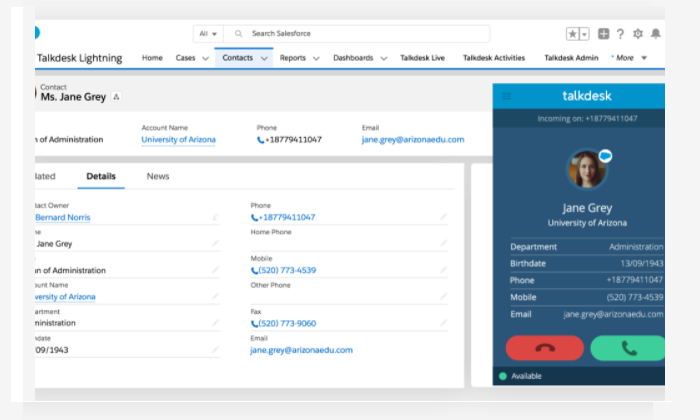
Talkdesk has more than 60 integrations ready to go, but the seamless connection with Salesforce CRM is definitely a key selling point. Agents can see a rich history of who they are talking to and all calls are automatically recorded in the proper place. 

When agents forget call details, they can listen back with a few clicks.

Some tasks, like creating new IVRs, take some getting used to, but for the most part, non-technical users are going to be able to get the most out of every feature, including:

  • Intelligent routing
  • Warm transfer
  • Customer sentiment surveys
  • Real-time dashboards for workforce management
  • Custom IVR
  • Guardian Standard fraud prevention

Talkdesk also offers AI-driven add-ons for speech analytics, workforce management, and quality control. 

Talkdesk has rolled out affordable solutions for SMB call centers. Adopting something this powerful early on will deliver superior customer engagement, and may even cut down on costs by increasing agent productivity.

Summary

Ten years ago, setting up a call center took months. Today, you can deploy one over the weekend.

To make your choice, focus on how the feature set of each product will:

  • Enable customers connect to the right agent quickly
  • Empower agents serve customers and connect with clients

While every option on this list is fairly easy to get set up, Dialpad or Aircall are exceptionally easy in this regard. Aircall will better accommodate legacy technology than Dialpad, if that’s a consideration, and the collaborative features are more mature.

Then again, it depends how you collaborate. The ease of routing calls between devices on Dialpad is phenomenal, which is critical for distrubed call centers.

Five9 has the edge on many other full-scale contact center software when it comes to outbound dialing capabilities. Sales teams can automatically ramp up their call volume without increasing call abandonment numbers. As the inbound call functionality is comparatively rich, Five9 is a great option for a blended call center.

Companies using Salesforce CRM will enjoy using Talkdesk. The integration works with ease and employee familiarity with the Salesforce interface makes adopting Talkdesk that much easier.

Choose 8×8 if your company is going to benefit from building out complex IVR pathways. It’s easy to design customer journeys in the visual, drag-and-drop editor, which really stands out from the crowd.

Additionally, the security in 8×8 is payment card industry compliant, so you can rest assured that connecting customers to sensitive information via IVR won’t cause problems down the line.

The post Best Call Center Software appeared first on Neil Patel.
Saturday, November 28, 2020

How to Choose The Right Technical SEO Agency

Got a crawling, indexing, or site-wide ranking problem?

SEO traffic isn’t just about having the right content.

One wrong technical SEO setting can bring your entire site down.

And many technical errors are so obscure that they go unnoticed for years.

Even small problems can add up, slowing you down and resulting in less traffic.

Technical SEO audits require specialized skills and in-depth expertise. Google is constantly changing it’s algorithms. If you want the audit done right, you’ll need someone that really knows that they’re doing. 

Well, I have good news. 

Step-by-step, I’ll walk you through how to choose a technical SEO agency that’s right for your business.

Whether you’re a small business that just needs an audit done right, or a major corporation that needs a complete SEO program, there’s an option for you.

Know Your Goals and Desired Outcomes

Most people only give technical SEO a second thought when things have gone south. It shouldn’t be this way. 

Why? 

Technical SEO is the backbone of every successful, long-term SEO strategy.

Here’s a few examples of when it’s worth making technical SEO a priority. 

Example #1: Traffic Drops After Publishing More Content

Let’s say you started your content push to get higher Google rankings.

You created, published, and promoted in-depth blog posts. 

After a while, Google rewards your efforts with higher rankings for some keywords. Your site traffic starts to increase. 

Things are going well.

So you keep publishing more content. And that’s when things go bad. 

Your traffic tanks. 

More content doesn’t always yield more traffic. Sometimes, it shrinks your organic traffic from.

I know it sounds crazy but this happens all the time.

Bloated sites with duplicate content make it really hard for Google to figure out which pages of yours to rank.

What does Google do when they’re not sure what to rank? They usually rank nothing.

Duplicate content on your blog, a ton of similar pages that were created automatically, or telling Google to index internal URLs can all lead to problems.

If you see anything like this, get a technical SEO to help you.

Example #2: An Abrupt Traffic Drop

If you play the SEO game long enough, one of your sites will fall off a cliff overnight.

Years ago, our blog at KISSmetrics saw traffic drop by 40% in less than a month.

That dropped our monthly traffic by hundreds of thousands of visitors. The team scrambled to fix that.

Everyone goes through one of these.

And the first thing you want to do is reach out to a technical SEO.

Hopefully, it’s a simple fix like a bad robots.txt file. Even if it’s a bigger problem, you want a serious expert to pinpoint the issue and chart a course to get that traffic back.

4 Characteristics That Make a Great Technical SEO Company

Not all agencies can develop, let alone implement, advanced technical SEO strategies. A reason for this is that it requires specialized skills and vast experience. 

So, how do you recognize those who can not only develop a technical SEO plan unique to your business but can also implement it for maximum results?

Such agencies work with a team of experts and the other characteristics I’ll discuss below.

1. Experience With Massive Sites

Smaller websites rarely have issues with technical SEO that are difficult to fix. In most cases, any problems can be solved by checking the robots.txt file, making sure the site is on a good platform (like WordPress or Shopify), and upgrading to a good web host.

If a small site struggles to rank, it’s usually because they need a lot more content and authority. Rarely is there a quick fix.

Large sites, however, are completely different.

When a site has millions of URLs, all sorts of insane problems come up. There can easily be thousands of junk URLs that never should have been indexed to begin with. Or terrible canonical errors that cause rampant duplication problems. Not to mention keeping everything clean between dozens of languages.

For sites like this, make sure you’re working with someone that has tons of experience working on larger sites.

Otherwise, they won’t have the experience need to spot your technical problems quickly.

2. A Holistic Process that Includes Technical SEO

As I’ve mentioned earlier, technical SEO is the backbone that gives your site structure. Occasionally, you will see some quick technical SEO fixes bring you traffic.

But what then?

After you fix your technical SEO, what’s your plan for growing SEO traffic over the long term?

We’ve seen lots of folks work on quick fixes and then never take the next step to growing their site by 2X, 5X, or 10X what they have now.

If it was me, I’d want to work with someone that could keep growing my site year in and year out. That’s where the real impact comes from.

If you have a gnarly technical SEO problem, work with a specialist. But an agency with deep SEO expertise across content, technical SEO, and promotion will take your business to an entirely different level.

3. Thought leadership

It takes patient experimentation to develop, plan, and implement technical SEO strategies.

And to show their processes and how they achieve results, exceptional technical SEO agencies publish their findings from experiments.

That’s one of the easiest ways to look for a top tier technical SEO agency. Find the folks that product the best content in the space.

After all, if they’re already doing great SEO, they can likely help your business too.

4. Been in the SEO Game Long Enough to Spot Patterns

Technical SEO can move really fast.

Google is always releasing new features, shutting down others, and changing their priorities.

It’s a shifting landscape.

Getting a great technical SEO that knows the rules today isn’t enough. Ideally, you’ll want to work with someone that knows where SEO is going in the coming months and years. Or at least can take a good guess at it.

The last thing anyone wants is to restructure their site and then have Google go in an entirely different direction.

How to Work With a Technical SEO Agency

Once you’ve picked an agency, then what?

How do you work with one? What should you expect when you hire technical SEO specialists?

Typically, the process looks like this. 

1. In-house Team Alignment

Most technical SEO agencies work as an extension of your in-house marketing team.   

To ensure the partnership between both parties starts smoothly, you should:

  • Hold an in-house stakeholder meeting to align your teams.
  • Communicate why you need to work with a technical SEO agency and how their work would impact your site and business.
  • Make sure everyone is truly onboard with getting help. The agency may help find problems but internal teams need to be motivated to fix them.
  • Appoint front-facing employees that’ll work directly with the agency. 

When you do this, it ensures there’s team alignment between your company and the agency. It also keeps the agency in sync with your goals. 

2. Discovery Session

The first task to expect when you contact a technical SEO agency is an invitation to share your business problems and needs relevant to technical SEO. 

A reason for this is to understand your business situation better and get ideas from their vast pool of experience on the best approach to take. 

This process starts with a discovery session.

The best technical SEO agencies are first there to help organizations develop customized strategies that drive business growth. But for them to help you, expect to share your needs via a discovery session.

3. A Paid Audit

For a lot of marketing agencies, they’ll do a bunch of research for free and pitch you a proposal on how they’ll accomplish your goals.

This usually makes a lot of sense. The marketing agency gives you a taste of what they can do, they charge for the execution of the plan itself.

Technical SEO agencies rarely work like that.

In their case, the value is the research. You’re hiring them to do a ton of digging on your site and surface every problem they can find.

So don’t expect free audits.

The agency usually has a standard rate based on the size of your site.

4. Audit Results

Once the audit is finished, expect a document that goes into every issue that the team found. You can also expect a call to go over all the results.

Have your team ask followup questions, get clarification, and get as much advice on implementation as possible.

Because after this call, you’ll have a choice.

Some technical SEO agencies will help with implementation too. They’ll go over what that looks like. Many will have a proposal ready to go just in case you want to move forward right away.

If you want to implement everything in-house, make sure that this work doesn’t get neglected. It’s easy for it to get lost in the hand-off. Break up the work as necessary and get all deliverables assigned to individuals that can carry them to completion.

5. Ongoing Work

If you’ve decided to work with that agency on an ongoing basis, you’ll get into a regular cadence of status updates, invoicing, and execution.

Since you’ve already completed an audit with the agency by this point, there shouldn’t be any surprises in how they work.

As long as they keep delivering great work, keep working with them. 

How to Find The Right Technical SEO Agency For You

To choose a technical SEO agency that’s right for you, I recommend you start with these steps: 

  1. Know your desired outcomes for technical SEO. 
  2. Make sure the agencies on your shortlist specialize in these goals.
  3. Pick the one with the best track record in that area. 

To make the selection process much easier for you, below you’ll find the best technical SEO companies below. 

The 5 Top Technical SEO Agencies

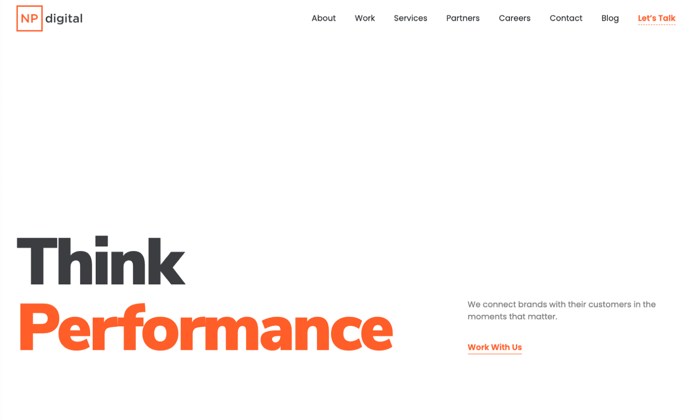
1. Neil Patel Digital – Best For Technical Content Structuring

No doubt, content is king. But content without a strong technical SEO foundation doesn’t yield long-term SEO success.

Ideally, you’d have both. Great content and smooth technical SEO.

At Neil Patel Digital, we excel at developing and implementing SEO-optimized content structuring that meets the necessary technical SEO requirements.

I truly believe we have one of the most comprehensive SEO programs in the world. We’d be a great fit if you really want to go for it.

Quite a few Fortune 500 companies have picked us to do just that.

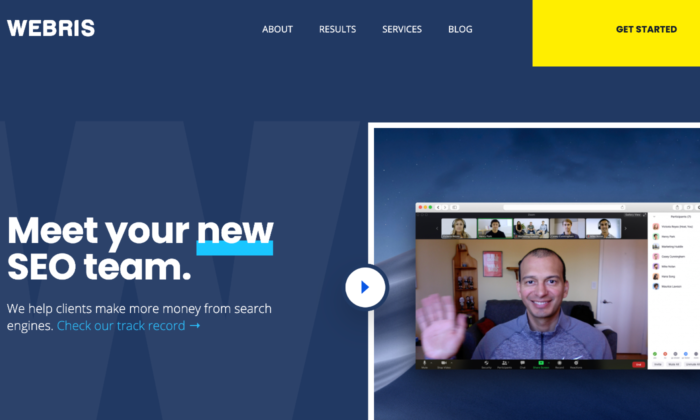
2. Webris – Best for Technical SEO Audits

Let’s say you feel really good about your SEO strategy. But something on your site is a little off. Or you just want to double check and make sure nothing’s missing.

In that case, a technical SEO audit would be a great fit for you.

The company I recommend for this kind of work is Webris. 

Their entire process is published here, take a look before you decide to contact them.

Led by Ryan Stewart, Webris boasts a talented team of advanced technical SEO experts trusted by government agencies and enterprise companies. 

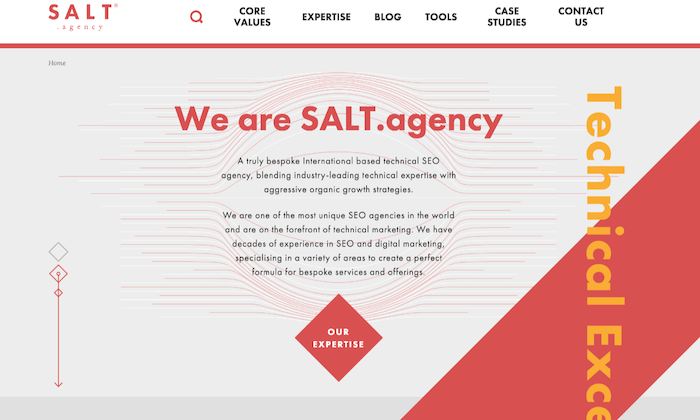
3. Salt.agency – Best for Technical Organic Optimization

Salt.agency’s core differentiator is how they blend industry-leading technical expertise with organic growth strategies to drive organic optimization.

They’re a good option for business that need more than just a technical SEO audit. If you know that you have SEO problems but aren’t sure where they are, they’ll be happy to dig in and give you guidance on your strategy.

They have offices in Leeds, Boston, and London and  customers that include Travel Supermarket, Cloudflare, Hartley Botanic, and many others.

4. Ayima – Best for Enterprise Technical SEO

Ayima positions itself as the technical SEO agency for enterprise companies. And this agency’s minimum project size is $25,000. 

This may seem on the high side from afar, but it only reflects Ayima’s vast experience and expertise, working with huge companies like eBay and British Airways. 

Ayima didn’t become the technical SEO agency for enterprise brands overnight. The company earned its stripes after transitioning from a search engine technology startup into a technical marketing agency.

In any space, the best agencies have people that have built products in that exact space. They really understand how it all comes together.

If you’re looking for hardcore technical SEO expertise, reach out to them.

5. Orainti – Best for eCommerce Brands

Orainti, a Spanish-based SEO agency, works mostly with ecommerce brands selling globally. 

This agency is excellent for developing SEO-optimized multilingual domains and a robust site structure for category pages and products.

Ecommerce sites have a lot of technical SEO problems that are completely unique for them. If you have a large ecommerce site, I’d definitely recommend working with an agency with deep ecommerce experience.

Most importantly, most of Orainti’s services is around technical SEO.

Founded by Aleyda Solis, a veteran SEO practitioner, author, and speaker, Orainti has an impressive portfolio of premium brands likeUnder Armour, Zillow, Sage, Eventbrite, and others.

Have a Plan for Technical SEO from Day One

Most businesses make the mistake of relegating technical SEO to the backseat.

Why?

Because from the onset, it doesn’t have much impact on rankings and traffic. 

A little time invested today could gain you thousands of extra visitors without any extra work later.

Don’t wait for things to go south. Make it easy for Google to find, index, understand, and rank your content.

No sense in jumping on the SEO treadmill while trying to carry a bunch of extra weight that will only slow you down.

Get a solid plan for technical SEO from day one. 

And if you need help, reach out to an agency that specializes in technical SEO.

The post How to Choose The Right Technical SEO Agency appeared first on Neil Patel.
Friday, November 27, 2020

6 Alternatives to Amazon For E-commerce

alternatives amazon

With a net worth of  $1.7 trillion, Amazon has dominated the e-commerce sector for years, leaving many of its competitors in the shade. But are there alternatives to Amazon?

With an audience as vast as Amazon, small business start-ups and solo entrepreneurs flock to the site to sell the products, get established, and build their enterprises. Despite the audience Amazon offers, you may want to look for other online venues to list your items.

There are many good reasons to broaden your e-commerce horizons.

First, it makes little sense to put all your eggs in one basket. Second, selling on a wider range of marketplaces gets your products in front of a larger audience. And finally, looking at the other choices available could save you money on fees, or get you closer to your target buyers.

Below are some viable alternatives to Amazon. We’ll look at their advantages, their fee structures, and what makes them different.

Why You Should Use an Alternative to Amazon for Your E-commerce Business

We already touched on one of the main reasons to seek other venues: the perils of depending on one sales platform.

It’s not unheard of for sellers to have their accounts blocked. If you haven’t already established yourself on one of the alternatives to Amazon, your business could tank.

However, by setting up multiple accounts with different marketplaces, you’ve got greater flexibility if things go wrong. Plus, you can use other online platforms to test out which ones are the best for your products.

And there are other benefits in finding additional marketplaces, like:

Greater Flexibility 

All e-commerce sales platforms have some measure of control over your business. They determine:

  • What products you can list
  • The terms and conditions of doing business
  • Your payment options
  • Shipping fees

These terms might not be suitable for your business. So, If you’re looking for greater flexibility, then seeking alternatives to Amazon is a good idea.

Better Customer and Vendor Support

Perhaps you feel the vendor or customer support is lacking. Amazon provides useful resources for sellers, like its university. But some sellers feel seller support is sometimes thin, especially when things go wrong.

More Shipping Options and Lower Fees With Some Amazon Alternatives

Amazon has changed its fee structure over the years, bringing frustration to some.

Amazon sets its professional selling plan at $39.99, with individual plans available free. And referral fees differ, depending on which category you’re selling in.

Shipping is a further reason to consider seeking alternatives as individual sellers on Amazon lack flexibility over their shipping costs.

If you’re looking to cut fees or branch out, then signing with some alternatives to Amazon may allow you to further scale your business while reducing costs.

Amazon Alternative Payment Choices

If you’re a seller on Amazon, you’ll know it makes payment via ACH or electronic funds transfer. Amazon distributes these payments to your bank account every two weeks, and they can take up to five days to clear.

But that doesn’t always work for everyone. If you’re a small business and cash is tight, signing up to e-commerce platforms with a broader range of payment options can improve your cash flow.

What to Look for in an Amazon Alternative

Before you search for alternatives to Amazon, you need to decide what you want from your business. You’ll need to consider the products you’re selling and your target customer, too.

For example, if you’re selling printable products, Etsy could be an excellent choice. Or, if you’re looking for consumers who understand tech, you may find Newegg works well for you.

Other areas you’ll want to think about include:

Ease of Use

Marketplaces that allow you to add items efficiently mean you can list more products in less time. But you’ll want to view any alternatives to Amazon from your customer’s perspective too.

How important is the ease of use? Well, if you note some recent research from Digital Commerce 360 and Bitrate, you’ll see this is a significant factor in the buying decision.

When researching new platforms, perhaps test them out for yourself and consider areas like:

  • Navigation
  • Ease of checkout
  • Payment options
  • Shipping choices

User Types

Think about your ideal consumer and the type of users the platform attracts. For example, eBay is huge, with 182 million active buyers. It’s great for snapping up limited-time deals, brand name products, and pre-loved items.

However, it’s not always the first place shoppers think of when looking for handmade goods or unique items. They’re more likely to head somewhere like Etsy.

Fees

Fees can take a considerable chunk of your profits if you’re not careful. Depending on the fee structure, some sites may not be suitable if you’re selling smaller, lower value items.

If you need some help in this area, fee calculators are helpful. Here’s a list of the well-known ones.

Best Alternatives to Amazon for E-commerce

What are some of the best Amazon alternatives when you’re looking to sell your products online? Let’s look at some of the top options, in no particular order.

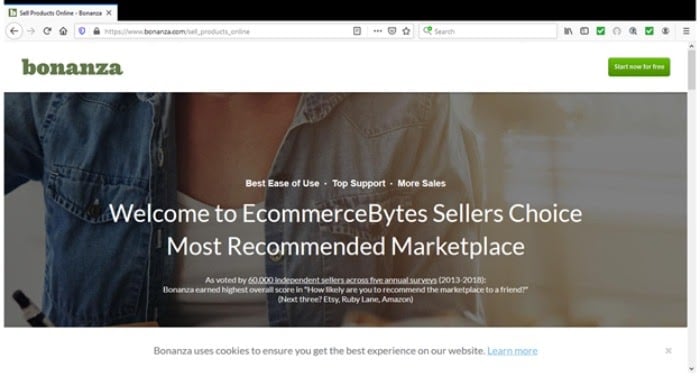
Bonanza

alternatives to amazon bonanza

Established in 2007, Bonanza has built itself a loyal following, with a vast range of categories. Sign up is free, and fees are straight forward. Final offer value fees are 3.5 percent for sales under $500. Sales over $500 attract an additional 1.5 percent fee.

Although it’s much smaller than Amazon, Bonanza has some advantages over its larger rival. They include a greater emphasis on building customer relationships and developing a sustainable business through repeat customers.

Equally appealing to sellers is the marketing tools Bonanza provides. These give you access to valuable data about product performance, allowing you to spot trends, optimize listings, and better market your items.

Other features include:

  • Automatic syncing with eBay, Amazon, and Shopify
  • Customized marketing tools
  • Image editing tools
  • Google integration
  • High level of customer support.

But what makes Bonanza stand out is its focus on unique items. It’s not trying to be another Amazon. As Bonanza puts it, it’s a site where you’ll find “everything but the ordinary”.

eBay

One of the most prominent alternatives to Amazon is eBay. Like Amazon, eBay has made considerable changes since its launch back in 1995. Over the years, eBay’s focus has moved away from the collectibles market it used to cater to, and it’s now more product-based.

Many famous brands like Rolex, Hasbro, and Microsoft make their goods available via ebay.com brand outlet site, enabling consumers to bag a bargain. But that doesn’t mean there isn’t still a place for more unusual or collectible items.

On eBay, listing fees and final value fees vary, but it sets many of its final value fees at 10 percent or less. If you need to calculate fees before listing, use an eBay fee calculator.

Some advantages of selling on eBay are:

  • A more comprehensive range of categories
  • More payment options for shoppers, like a credit/debit card, PayPal, and local collection. Sellers can also accept Apple Pay, Google Pay, and gift cards through managed payments.
  • Improved branding through eBay stores and marketing materials

What makes eBay stand out, though, is its auctions. Auctions may not be ideal for every business. However, sellers who specialize in collectible or rare items may find the bidding pushes their final sales price up higher than they could’ve imagined.

Etsy

If your business primarily sells printable products or art and craft items, then Etsy might be for you. Of the many alternatives to Amazon, Etsy has perhaps one of the most affordable and straightforward pricing approaches.

Each listing costs just 20 cents, and the listing is good for four months. Then there’s a five percent transaction fee for goods that sell. Payment processing fees are variable and depend on location. If you want to grow your business further, Etsy Plus is available at $10 a month.

Re-listing is simple, too. Just select the auto-renew option, and there shouldn’t be anything else to do on your part.

Advantages of selling on Etsy are:

  • Greater customization over how your store looks
  • Ideal for beginners
  • Lower fees
  • Sellers can list collectibles and vintage items on Etsy

That’s the advantages, but there are a couple of possible disadvantages worth mentioning. First, Etsy is much smaller than Amazon, which means there’s intense competition, so your products need to stand out.

Second, although fees are cheaper, you may make more sales on Amazon Handmade because of its larger audience share.

Walmart Marketplace

Amazon dominates e-commerce, but Walmart is gaining ground. Recent sales figures show Walmart’s e-commerce sales have soared by 74 percent. This stat means if you’re looking for alternatives to Amazon, Walmart could be promising.

Like Amazon, Walmart now offers a fulfillment service. Although storage and fulfillment fees apply, Walmart’s fee structure is less complicated than Fulfillment by Amazon, and referral fees are competitive.

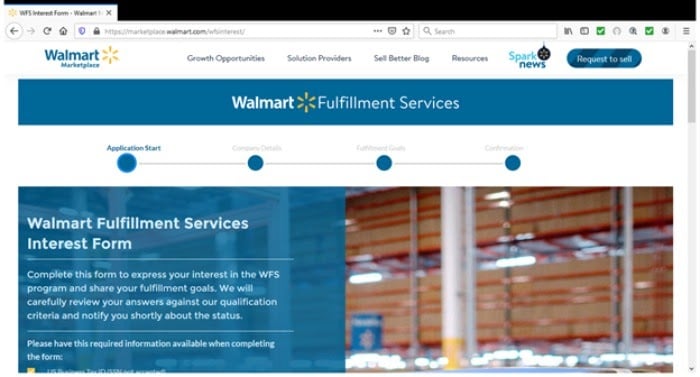
alternatives to amazon walmart interest form

In addition, with Walmart’s marketplace, there’s no start-up or ongoing monthly fees. However, you’ll want to factor in other costs, like unique product codes (UPCs).

Advantages of selling on the Walmart marketplace include:

  • Lower costs
  • Less competition due to buyer/seller ratio
  • Price control over inventory

What makes the platform different? Unlike Amazon, Walmart’s marketplace is only open to invited brands. You can’t just register and start selling. But you can sign up.

To register your interest in selling, Walmart asks businesses to fill out the interest form.

Newegg

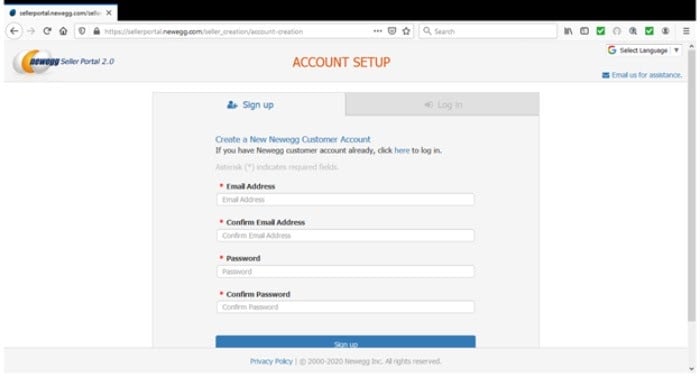
alternatives to amazon newegg

Newegg has gained a reputation as the top global tech marketplace online. But it also sells apparel, home and lifestyle products, sports/health-related items, TVs, and plenty more.

As for fees, non-elite membership is free. Elite membership has two tiers ranging from $29.95-$99.95 a month. Commissions vary, with the highest being 12 percent.

Advantages of selling on Newegg include:

  • Can be cheaper for tech products
  • Attracts tech buyers who are knowledgeable about products
  • The Newegg search engine makes finding electronics and components quicker
  • Customized marketing for businesses
  • Various payment choices for sellers including weekly ACH payments, PayPal, Wire Transfer, PingPong, Payoneer, and World First
  • A wide range of payments for buyers, including PayPal and BitPay

But it’s the multi-channel fulfillment option that may interest sellers the most. If you’re selling from various platforms, Newegg provides a central point to manage all your orders.

Shopify

When you sell on a third-party platform, you have limited control. Many online sellers favor setting up their stores the Shopify platform.

The site offers new sellers a 14-day free trial to get them started. After that, a basic Shopify store will cost you $29 a month. Online credit card rates are 2.9 percent + 30 cents. And you should find it easy enough to start selling.

Once you’ve signed up for the free trial, the next steps are to:

  • Add products
  • Selecting images
  • Set shipping details
  • Customize pages for search engines using keywords
  • Create main pages
  • Customize store

The benefits of Shopify include:

  • Highly-rated customer support and selling features
  • Greater customization
  • Large range of e-commerce tools and apps
  • Access to the e-commerce university
  • You can accept a large range of currencies

Conclusion

There are a variety of reasons you might be looking for alternatives to Amazon. Maybe you want a platform that provides a wider range of payment options, a site that’s more niche, or you just want a more extensive selection of online marketplaces to sell your wares.

As you can see, there are many venues available, and they all have their advantages. Sites like Bonanza have established a loyal audience, and Walmart’s e-commerce presence is growing strong.

Niche sites such as Etsy and Newegg are ideal for specialist items, and eBay offers greater customization and various selling methods, including auctions.

If you want to go it alone, there’s always Shopify, where you can set up and market your own e-commerce business.

Are you an online seller? Tell us about your favorite platform and your experiences below.

The post 6 Alternatives to Amazon For E-commerce appeared first on Neil Patel.
Thursday, November 26, 2020

The Best Luxury Marketing Strategies

luxury marketing

Have you ever seen a Facebook ad for Chanel? Or an Instagram ad for Lamborghini?

Me neither. That’s because luxury marketing strategies don’t follow the same rules as mass-market brands.

Selling to high-end consumers requires a different approach. But that doesn’t mean popular digital channels are off-limits.

SEO, PPC, even some social media sites can drive online sales for your luxury brand.

Today, I’m going to show you exactly how to take your luxury brand online with the best luxury marketing strategies.

What Qualifies as a Luxury Brand?

Gucci, Rolex, Ferrari. For the most part, you know luxury brands when you hear them.

But what does it take for a brand to qualify as a luxury? In my opinion, it’s down to the three Es: Expensive, Excellent, and Exclusive.

Luxury products are synonymous with high price tags. This is the most common indicator of luxury, but it is also the most misleading. Just because something costs thousands of dollars doesn’t mean it’s luxury.

That’s why luxury products also need to be excellent. The quality has to match the price tag. Good doesn’t cut it in the luxury category; a brand has to be at the very top of the market.

Luxury fashion is created by the best designers in the world. The best engineers create luxury cars. Ditto for timepieces.

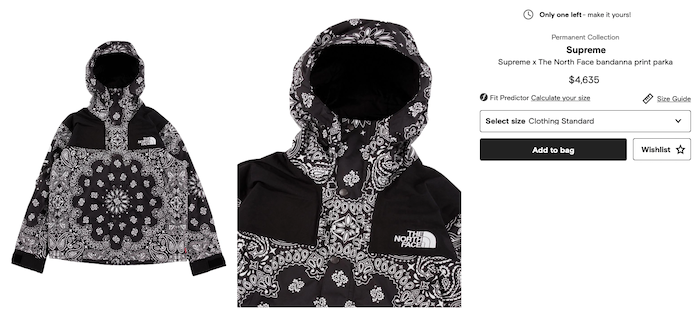
Finally, luxury products have to be exclusive. It’s not a luxury product if everyone has one. Often, exclusivity is achieved by price. A ten thousand dollar handbag is well out of reach of the majority of consumers. But brands can also achieve exclusivity by selling a limited number of products. Or they can do both, like Supreme.

Luxury Marketing Supreme

Luxury Marketing Trends

According to Statista, the global luxury goods market will increase from $285.1 billion in 2020 to $388 billion in 2025.

Despite what you might think, online sales of personal luxury goods are growing, too. McKinsey estimates 8% of all luxury sales are made online or around €20 billion. That’s a five-fold increase from 2009. What’s more, the majority (almost 80%) of purchases made in-store are influenced by digital.

The consultancy expects online luxury sales to triple by 2025 when almost one in five personal luxury sales will happen online.

Digital channels will be essential for luxury brands going forward. The pandemic hit department stores hard and forced luxury consumers to buy online more than before.

BCG predicts the e-commerce boom will continue in the future both for inspiration and for transactions.

Going digital will also be key to meeting today’s new luxury consumers and those of tomorrow. Millennials, who are entering their peak earning years, and Gen Z, many of whom are just entering the workforce, have grown up in the digital era and expect brands to have an online presence as high-quality as their products.

All that’s to say: digital marketing must be a key part of a luxury brand’s strategy going forward.

Luxury Brand Marketing Strategies

Here’s the thing, luxury marketing isn’t synonymous with digital marketing…yet.

Until now, luxury brands have been able to rely on full-page ads in premium magazines, billboards in duty-free stores, and high-end, high budget TV ads.

Not any more.

To survive in the increasingly competitive luxury space and attract new customers, luxury brands must understand what the luxury consumer wants from a brand and how digital can help them get there.

From SEO to PPC, apps to AR, there are loads of marketing strategies to explore.

Understand the Luxury Customer

The first step in developing a luxury marketing strategy is to understand your audience. Enter buyer personas.  

A buyer persona is a detailed description of your ideal consumer. It will include their age, demographic, job, hobbies, salary, and anything else relevant. The more detail you can include, the better.

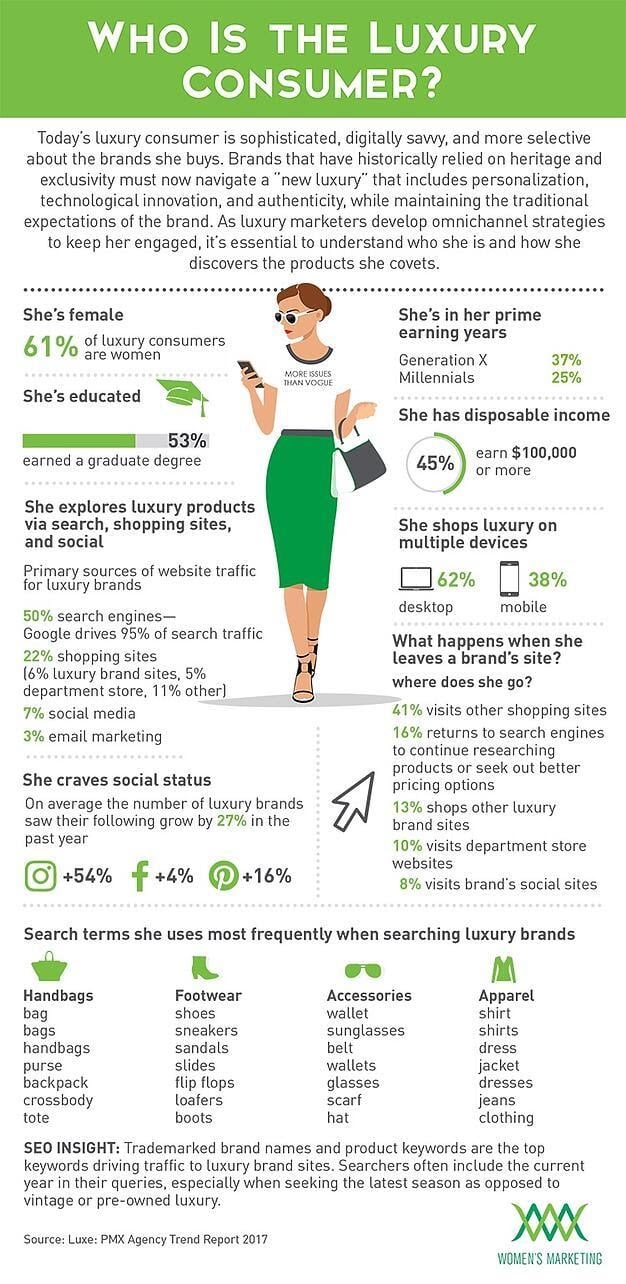
Here’s an example of a luxury consumer persona from Stella Rising.

Luxury Marketing Consumer

Keep in mind; you may not have just one buyer persona. If several different groups of people buy your products, you’ll need to develop a buyer persona for each of them.

Detailed buyer personas help your brand understand precisely who your customers are and what they want from your brand.

They will allow you to better communicate with your customers and focus your marketing efforts.

Develop Your Digital Luxury Marketing Strategy

Now you understand who your customers are and what they want from your brand, you can build a marketing strategy that will drive results.

Start by thinking about the channels you want to target. This could be a social media platform you want to pay particular attention to; it could be Google; it could even be a custom app.

Focus on one or two to start with, particularly if your luxury brand is new to digital marketing.

Next, define your goals. This may be increasing brand awareness, but a better and more measurable goal is an increase in sales. (It’s also easier to measure sales increase.)

Finally, work out how you’re going to measure your success. If you’re going to use SEO to increase revenue, for instance, find out how much revenue Google and Bing are responsible for right now. If you don’t already have Google Analytics tracking in place, now’s the time to set it up.

Experimental vs. Traditional Marketing

Most marketers are aware of traditional luxury marketing tactics. Full-page ads in premium magazines or weighty direct mail pieces are a luxury marketer’s bread and butter.

But those strategies won’t cut it in an increasingly digital world.

Many brands consider digital marketing experimental in itself. But I urge luxury brands to go beyond standard digital marketing tactics and explore more experimental channels.

One option is a brand app. Apps offer brands a way to speak to users directly through their smartphones. Your app could be as simple as a mobile responsive version of your website.

Or you could take things even further by integrating augmented reality features. Burberry, for instance, has launched an AR shopping tool that lets consumers see Burberry products in their surrounding environment.

Chanel has combined offline marketing with digital marketing in a holiday popup event at The Standard in New York. An AR app, which could be accessed on the Chanel website or via Snapchat, brought the popup to life.

Role of Loyalty in Luxury Marketing

Luxury brands have loyal consumers. This is important because the more loyal your customers, the less marketing you have to do.

Don’t worry; I’m not recommending creating a loyalty program. That could devalue your luxury brand.

Rather, you need to turn consumers into fiercely loyal brand advocates. One way to do that is through the quality of your products. Another way is through the quality of your marketing.

You can also partner with influencers on social media channels. Influencer marketing is incredibly cost-effective and, if done well, can put your brand in front of the right kind of consumers.

Just make sure to find influencers who already operate in the luxury space and whose audience buys the products they promote. Aspirational jet-setting influencers are a dime a dozen.

You want to work with the few who have the audience to back it up. Otherwise, you won’t see results.

Develop a Targeted Luxury Marketing Keyword Strategy

Whether you’re running an SEO campaign or a PPC campaign (or both), I recommend developing a highly targeted luxury marketing keyword strategy.

Start by targeting high-conversion keywords. Sure, attracting consumers in the research phase of their journey is important. But for the sake of your ROI, you’re going to want to target consumers who are ready to purchase.

The CPCs of luxury marketing terms can be expensive, given the competition and the price of products.

Try to advertise as the “top watch maker” on Google, and you’ll pay $80 per click. Ouch.

Luxury Marketing Top Watchmaker

Or $50 to advertise as one of the best luxury compact cars.

Luxury Marketing Compact Car

If you want to see a return on your investment, focusing on high-intent keywords is essential.

You’ll also need to make careful use of your negative keyword list.

Unless you’re using negative keywords, you aren’t really in control over what terms your brand will appear. The last thing you want is for ads for your luxury brand to start showing up in searches containing “discount,” “sale,” or “free.”

The kind of consumer that clicks on those ads won’t match your buyer persona. Here’s how to add negative keywords to your ads.

Luxury Marketing Content Campaigns

A huge part of luxury marketing revolves around storytelling. Whether it’s the history of your brand or the craftsmanship of your products, you probably have a lot to say.

This makes content marketing campaigns a must for luxury brands.

What should you write about exactly? Well, apart from telling your brand story, I recommend using long-form content to help consumers find the right product for them.

Buying a luxury product is often a big decision, and consumers research their choices thoroughly before committing. Buying guides put your brand front and center for consideration while providing value and establishing a relationship even before the purchase has been made.

This is a strategy my team at NP Digital adopted for a prominent jewelry retailer that wanted to increase online sales.

We wrote a comprehensive piece of content about finding the perfect engagement ring that helped traffic from search engines to grow from 20% of all traffic to 30% of all traffic in the first six months of our partnership.

Your content can continue to add value for customers after purchase. Detailed guides on using and caring for luxury products make for excellent blog posts that can increase brand loyalty while attracting even more consumers.

Use the keywords you’ve discovered above to guide your content creation process. You’ll want to make sure there’s some form of content for every key term, whether that’s a category page, a blog post, or something else entirely.

SEO For Luxury Brands

Search engines are massive traffic drivers for luxury brands and play an important role in both the research and purchase phase of the consumer journey.

Yet, they are consistently undertilized by luxury brands. It doesn’t help that luxury brands tend to have poorly designed (but very good looking) websites and a lack of content for Google to crawl.

As I said above, creating new content is critical for luxury brands who want to succeed online. Targeting new, high-intent keywords is also important.

But you shouldn’t forget about the more technical aspects of SEO, like optimizing category pages. Or off-page factors, like building links.

The more time and effort you devote to understanding and implementing SEO, the more revenue your store should generate. For instance, we increase the revenue of our luxury jewelry client by 21% through SEO.

While Google should be your focus, don’t forget about Bing. Users of Microsoft’s search engine tend to be more affluent, with 25% of users having an income in the top 25%. It makes sense to focus some efforts on Bing SEO.

Conclusion

The luxury market is changing.

Luxury marketing can no longer be confined to TV channels, billboards, and glossy magazines. Now is the time to take your luxury brand digital and invest in SEO, PPC, and whatever social media your consumers use.

So here’s my question to you:

What will be the first digital channel you use to promote your luxury brand?

The post The Best Luxury Marketing Strategies appeared first on Neil Patel.